
MC
Pharmaceutical Labeling Machine
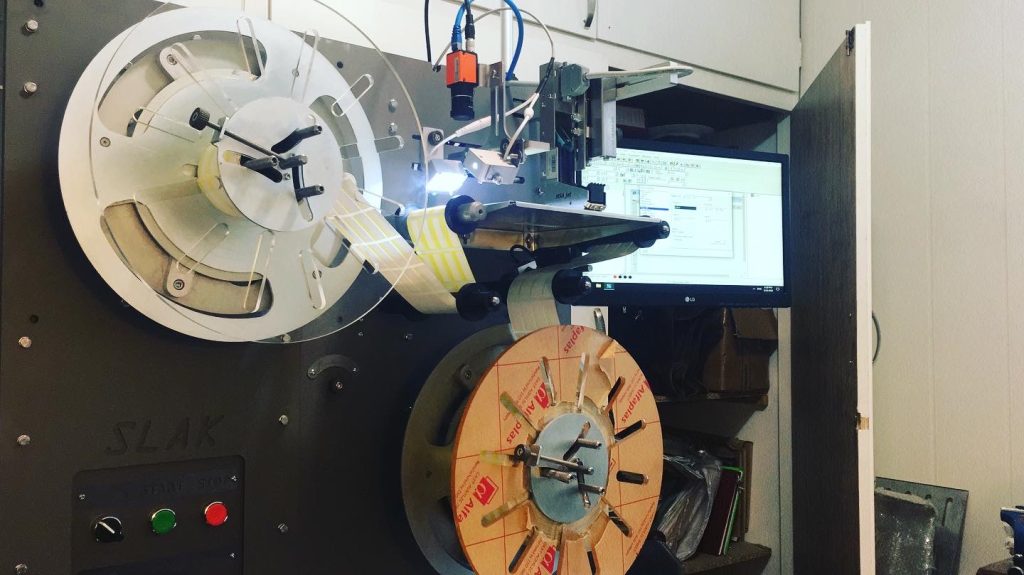


Precision Labeling Through Motion, Control, and Vision
Overview
The Pharmaceutical Labeling Machine is designed to provide high-speed, precise, and fully synchronized labeling for cartons, bottles, and vials within pharmaceutical production lines.
Developed under my direction, it integrates servo motion control, industrial printing, and vision inspection — ensuring every label is perfectly placed, verified, and compliant with serialization standards.
From its early prototypes to the latest generation, this system has evolved through constant innovation, testing, and mechanical–electrical optimization.
Mechanical & Motion Design
At the heart of the system lies a servo-driven labeling platform, capable of microsecond synchronization between label feed, product detection, and conveyor motion.
The mechanical design focuses on:
Precision label alignment even at high speed
Tool-free adjustments for product size changes
Compact modular frame for flexible integration
Anti-vibration mounts for inspection stability
These refinements ensure consistency and repeatability across long production runs — essential for pharmaceutical-grade labeling.
Printing & Verification
The system supports HSA TIG industrial inkjet printers (HP TIJ-based) and other print technologies for DataMatrix or human-readable code printing directly on labels.
After printing, an integrated industrial vision camera performs code verification and readability scoring in real time.
Invalid labels are automatically rejected or flagged before reaching the roll rewinder or product application stage.
This guarantees 100% traceability and compliance with GS1 and IFDA serialization regulations.
Electrical & Control System
Designed and implemented using EPLAN, the electrical cabinet integrates components from FATEK, Schneider, Omron, and Pepperl+Fuchs, combining reliability with serviceability.
The PLC control architecture manages:
Servo axis coordination for feed and cutting
Label gap sensing and product synchronization
Alarm and reject logic for defective labels
HMI-based diagnostics and setup control
Each subsystem is designed for modular expansion — enabling future integration with Inline Aggregation or Checkweigher systems.
Integration & Workflow
The labeling machine can operate:
As a standalone unit for offline labeling, or
Integrated inline with production lines for synchronized operation.
It connects directly with the Track & Trace server for serialization data management and communicates label validation results to the central production database.
Evolution & Future Development
Across multiple iterations, the system has advanced in:
Servo precision and torque feedback
Print–scan timing coordination
Modular design for easier service
Integration readiness with future robotic and vision-based modules
The next-generation labeling platform under Aknova Engineering will feature AI-assisted alignment, automatic roll calibration, and remote diagnostics — pushing pharmaceutical labeling toward the era of smart automation.
My Role & Vision
As the lead electrical designer and R&D director, I developed the complete control logic, servo parameterization, and electrical design — from concept to commissioning.
Working closely with mechanical and software engineers, I focused on merging precision motion with operational simplicity.
This machine represents my ongoing mission:
To turn complex automation challenges into elegant, reliable, and intelligent solutions.
Electrical Panel Design (EPLAN)
PLC & Motion Control
Machine Vision Integration
Pharmaceutical Packaging Solutions